

What Is Sound Healing?
Sound healing is the therapeutic application of sound frequencies to the body and mind with the intention of restoring harmony, balance, and health.
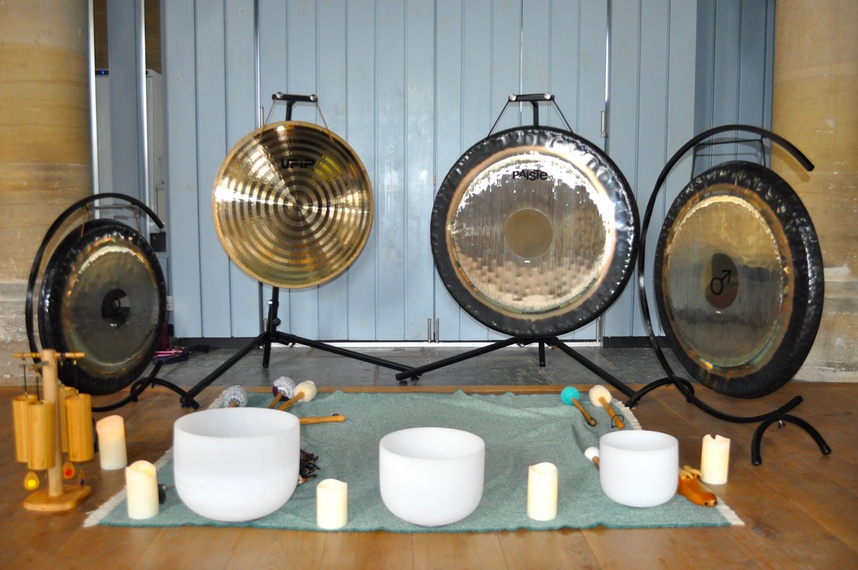
Sound is a form of energy. In sound healing, this energy is applied through the use of the voice, tuning forks, gongs, singing bowls, and other resonant instruments. These sounds create vibrations that can be heard and physically felt within the body.
One of the key ways sound healing works is by calming the mind and nervous system. When the mind relaxes, a person can access deeper layers of awareness where healing and regulation naturally occur. Sound healing may support relief from stress, pain and discomfort, muscle tension, insomnia, water retention, and other imbalances.
How Does Sound Healing Work?
Modern science recognises that everything that appears solid is made up of vibrating energy. Every object resonates at its own unique frequency — including every organ, bone, nerve, and cell in the human body.
The human body is an excellent conductor of sound because it is made up of approximately 65% water, found in blood, plasma, lymph, extracellular fluids, and within the cells themselves.
How Sound Travels Through the Body?
- Sound travels through air at approximately 340 metres per second
- In water, sound travels at around 1500 metres per second
- This is 4.5 times faster than in air
Because of this, sound vibrations can travel efficiently through the body, supporting health and balance at a cellular level.
The Body as an Orchestra
You can think of the human body as an orchestra. When we are in optimal health, our internal rhythms work together in harmony:
- Heartbeat: 60–75 beats per minute
- Breathing: 14–16 breaths per minute
- Craniosacral rhythm: 8–12 cycles per minute
- Gastrointestinal rhythm: contracts once per minute
- Stomach: contracts every three minutes
- Brainwaves (waking state): 18–22 cycles per second
When these rhythms are aligned, the body functions smoothly. However, when one part of the system becomes “out of tune,” it can affect the whole. Introducing strong, balanced sound frequencies can help the body return to its natural state of harmony.
Principles of Sound Healing
Sound healing works through several interrelated principles:
- Entrainment
- Harmonics
- Intention
- Intervals
- Body Rhythms
- Brainwaves
Entrainment
The principle of entrainment was identified in 1665 by Dutch scientist Christiaan Huygens. He observed that when two rhythmic systems operate near the same frequency, the weaker rhythm naturally synchronises with the stronger one.
Systems theory explains this by stating:
“It takes less energy to pulse in cooperation than in opposition.”
A common example of entrainment is geese flying in formation, where energy efficiency is achieved through synchronised movement.
In sound healing, if part of the body — such as the nervous system — is dysregulated, introducing a strong, coherent frequency can help it relax and recalibrate.
Tuning Forks and the Nervous System
Biosonic tuning forks tuned to C (256 Hz) and G (384 Hz) create the musical interval known as a perfect fifth — one of the most balanced ratios found in nature and the human body.
These frequencies are commonly used to support:
- Nervous system regulation
- Emotional balance
- Blood pressure regulation
This work is attributed to John Beaulieu, who spent over 500 hours in an anechoic chamber studying the sound of the human nervous system. He discovered that stress and anxiety produced higher-pitched internal sounds, and that tuning forks — particularly C and G — helped restore balance. The ratio of these notes (3:2) mirrors the blood pressure ratio of 120/80.
Harmonics
Every sound has a fundamental frequency, but what we actually hear is a complex blend of frequencies called harmonics. For example, when a C note at 256 Hz is played, it produces:
- 256 Hz – C (fundamental)
- 512 Hz – C (octave)
- 768 Hz – G (perfect fifth)
- 1024 Hz – C
- 1280 Hz – E
These harmonic relationships were explored by Pythagoras, who used a monochord to study mathematical ratios in sound. He viewed the universe — or cosmos — as a system of harmonic order.
Harmonics and the Human Voice
Vowels emphasise harmonics. Vocal overtone singing — developed in Tuvan, Mongolian, and Tibetan cultures — demonstrates how subtle sound can produce powerful harmonic effects. Interestingly, the softer the sound, the more harmonics are present, which is why gentle vocal tones can be deeply soothing, much like a mother calming a baby.
The Thymus Gland and Sound
The thymus gland, named from the Greek word for life energy, is located behind the breastbone. It plays a vital role in immune function and energy regulation. Dr. John Diamond identified a simple technique called the “thymus thump” to stimulate this gland. Gently tapping the area while smiling and vocalising “ha-ha-ha” can quickly energise the system.
The Cosmic Octave
Swiss scientist Hans Cousto, author of The Cosmic Octave, calculated planetary cycles and converted them into musical frequencies. By scaling the Earth’s annual orbit into an audible range, he identified the tone 136.1 Hz (C♯) — often associated with the sound AUM. These frequencies are now used to create planetary tuning forks and gongs, bringing cosmic rhythms into sound healing practice.
Intention in Sound Healing
Intention is central to sound healing. Every action carries conscious or unconscious intention. When sound is offered with clarity and care, it carries that intention to the recipient. This is why consent is important. If offering sound healing without spoken permission, practitioners use unconditional intention, such as:
“I offer unconditional love, light, and peace.”
Musical Intervals and Emotional Response
Musical intervals — the space between two notes — affect the body and emotions differently:
- Thirds and fifths are uplifting and stabilising
- Minor intervals can evoke introspection or sadness
- Dissonant intervals may help access deeper emotional material
These intervals are based on simple mathematical ratios found throughout nature — in shells, leaves, crystals, the human body, and planetary orbits. Goethe famously described architecture as “frozen music.”
Body Rhythms and Brainwaves
- Music at 60 beats per minute can shift brainwaves from Beta to Alpha
- Repetitive drumming can induce Theta states, associated with trance and deep meditation
- These rhythms are commonly used in shamanic and sound healing traditions to access subconscious awareness and facilitate healing
By gently guiding the brain into slower wave states, sound healing allows the body and mind to release protective patterns and access deeper restorative processes.